Third Puzzle Piece
So far, I have found a primary source from each organization that I want students to analyze and think about the words used in these sources to describe demonstrations, the President, and propaganda in light of World War One. These sources are long and will have to be narrowed to specific protests; I may narrow them down to the peace talks in France in December of 1918, as this was when the National Women’s Party escalated to the watchfires. There are not many descriptions in the newspapers of these events, maybe due to the overwhelming coverage of Woodrow Wilson in France.
One, The Front Lobby, describes the work of the lobbyist of the NAWSA, and she explains how the suffragists worked in Congress to get support for Susan B. Anthony Amendment. In this source, the work of the NAWSA is contrasted with the “militants” of the movement. The second source is the book, Jailed For Freedom as the source from the National Women’s Party. This source described the work by the National Women’s Party, the “militant” suffragists with their DC silent sentinels, to the watchfires and protests from 1917 to the passage of the 19th amendment. The third source is “The Woman Patriot,” a DC newsletter written by anti-suffragists who described the activities of the suffragists as riots, socialists, and pro-German and anti-patriotic.
Other sources I have found and plan to incorporate possibly are the African American paper, The Washington Bee, and additional newspaper articles about protests in Washington, DC. I also will contain links to all the different websites that include further information on the overall history of suffrage. This lesson is limited to the years before the passage of the 19th amendment and the language used by the different groups with propaganda during World War I and after. Images I also plan to use are pictures of the watchfires, which are limited but need to be included and can be analyzed along with the primary documents. I will help the audience with the images based on the dates and background of World War I dates since this is a focused segment on woman suffrage and anti-suffrage.
Document Sources so far
Park, Maud Wood, Carrie Chapman Catt, and National American Woman Suffrage Association Collection. Front Door Lobby. [S.l.: s.n., 192, 1920] Manuscript/Mixed Material. https://www.loc.gov/item/93838361/.
Stevens, Doris. Jailed for Freedom. United States: Boni and Liveright, 1920. Library of Congress.
The Woman Patriot. United States: Woman Patriot Publishing Company, 1918.mGoogle Digitized.
Richmond times-dispatch. [volume] (Richmond, Va.), 02 Sept. 1919. Chronicling America: Historic American Newspapers. Lib. of Congress. <https://chroniclingamerica.loc.gov/lccn/sn83045389/1919-09-02/ed-1/seq-4/>
Images
These images in the list may be used for this lesson plan, and is not the final list. These images show the events of the suffragettes who picketed at the White House, a political cartoon, and an ad. All of these were during or immediately after World War I. I would also like to find anti-suffrage images to add to the lesson for analysis. The challenge I am seeing is—ok, so I have these different sources for evaluation. What do I want the class and objectives to be? What website do I want to develop? Omeka or Google sites? What will the website do? Do I make it interactive or just a lesson plan to compare the sources? With the focus on DC, Virginia, and Maryland, I could also add a segment. For example, find a voice from either side and write an analysis of how you researched the person, where she was within which group, and her importance. There are many women in the Equal Suffrage League of Virginia, the Suffragist (National Women’s Party), Maryland Suffragist News, National Women’s Suffrage Association, and the Woman Patriot and Women Opposed to Suffrage that could be researched and discuss their contribution to their organization. I also want to show how World War I and suffrage propaganda helped further their cause. At the same time, anti-suffragists also used World War I terminology and words in opposition to women’s suffrage. Women’s suffrage was supported in the Washington Bee, and African American newspapers that could also be added despite the racism found in the documents by all three organizations.
[Two suffragettes and bonfire at front gate, White House, Washington, D.C.] (loc.gov)
3c13716r.jpg (640×512) (loc.gov)
Harris & Ewing, Washington, D.C. Party watchfires burn outside White House, Jan. United States Washington D.C, 1919. Jan. Photograph. https://www.loc.gov/item/mnwp000303/.
The Washington times. (Washington, DC), Jan. 9 1918. https://www.loc.gov/item/sn84026749/1918-01-09/ed-1/.
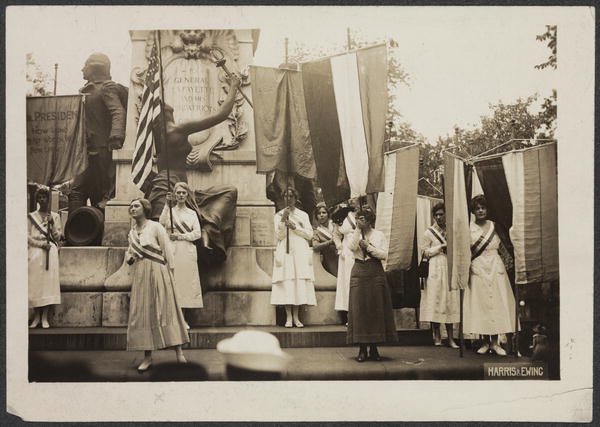
Harris & Ewing, Washington, D.C. Suffrage demonstration at Lafayette Statue to get the last vote in the Senate before June 4. United States Washington D.C, 1918. [Sept. 16] Photograph. https://www.loc.gov/item/mnwp000191/.


. United States Washington D.C, 1919. Jan. Photograph. https://www.loc.gov/item/mnwp000303/.

